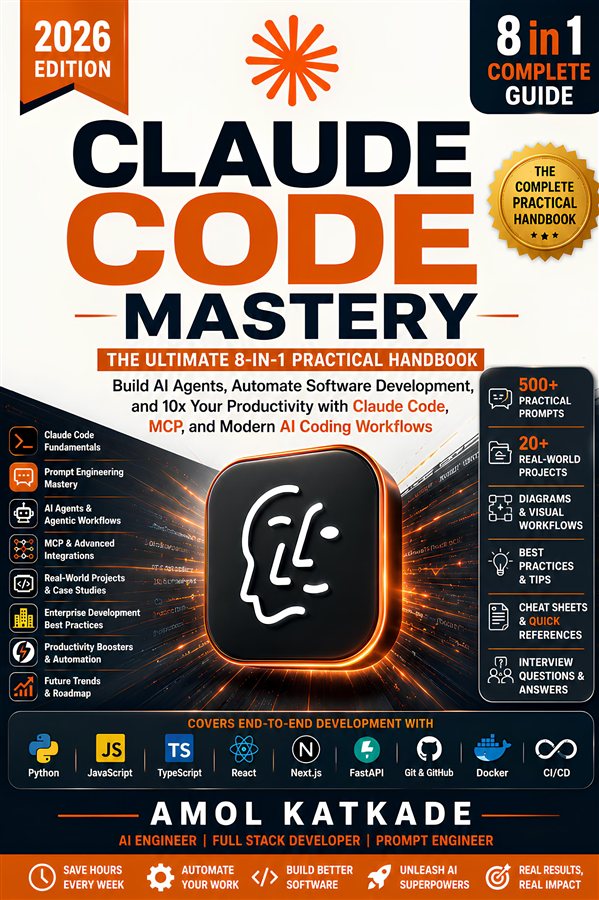
Claude Code Mastery
Build AI agents, automate software development, and 10x your productivity with Claude Code, MCP, and modern AI coding workflows.
by Amol Katkade
The definitive practical guide to Anthropic’s Claude Code — the terminal-native AI agent redefining developer productivity. 32 chapters covering prompt engineering, project memory, multi-file refactoring, TDD, debugging, Git, MCP integrations, the Agent SDK, and four complete hands-on projects — with exercises, diagrams, and cheat sheets throughout.
- 32 chapters + a 300+ field-tested prompt vault
- Master the CLI, VS Code & CI pipelines
- MCP integrations + build your own MCP servers
- Four full projects: REST API, RAG chatbot, dev-assistant, autonomous bug-fixer
≈ $5 USD · charged in INR at checkout
30-day satisfaction guarantee · Delivered instantly to your library
From the opening pages
In early 2024, I watched a colleague spend three days building a feature that, eighteen months later, I rebuilt in an afternoon. Same feature. Same complexity. The difference wasn’t that I had become a dramatically better engineer — it was that I had learned to direct an AI agent through the work. This book is about that shift: from typing every line to orchestrating an agent that reads your codebase, plans a change, edits dozens of files, runs your tests, and iterates — under your supervision, at machine speed.
Table of contents (excerpt)
- Part I: Foundations
- Chapter 1: The AI Coding Revolution
- Chapter 2: Installing and Setting Up Claude Code
- Chapter 3: Your First Hour with Claude Code
- Chapter 4: Project Setup and Memory: CLAUDE.md Deep Dive
- Chapter 5: Context Management
- Chapter 6: Prompt Engineering for Code
- Chapter 7: Planning and Reasoning
- Chapter 8: Working with Large Repositories
- Chapter 9: Refactoring at Scale
- Chapter 10: Testing and TDD
- Chapter 11: Debugging with AI
300+ pages · instant PDF download
Reviews & reader feedback
Be among the first to review this guide
This guide is newly published, so there are no reader reviews yet. Early readers who send honest feedback help shape the next edition — and every published review credits you by name, role and company if you want it.
- Launch pricing while the programme runs
- Free lifetime updates to the guide
- Your feedback shapes the next edition
- Credited by name on the product page
We publish honest reviews — including critical ones. Nothing here is incentivised in exchange for a positive rating.
Write a review
Read the guide? Share what worked and what didn't. Reviews are moderated before publishing, and honest criticism is welcome.


Why this book exists
The only book here written for developers who already ship code and want an agent inside their actual workflow — Git, tests, refactors, CI — rather than in a chat window beside it.
Terminal-native coding agents change how a developer works, and almost everything written about them is a feature tour. What is missing is the operating discipline: how to manage context on a large repository, how to keep an agent useful across a refactor that touches forty files, and what to do when it confidently breaks something.
Who this is for
- Working developers who write code every day
- Engineers adopting Claude Code on a real codebase, not a toy one
- Teams standardising how they use AI coding tools
- Anyone building MCP integrations
Who should not buy it
- People who do not already program — this assumes you can read and write code
- Readers wanting a conceptual overview of AI; this is operational
- Anyone looking for Python or machine-learning fundamentals
What is actually inside
Read from the PDF itself — 732 pages, not written for this page.
- Part I: Foundations
- Chapter 1: The AI Coding Revolution
- Chapter 2: Installing and Setting Up Claude Code
- Chapter 3: Your First Hour with Claude Code
- Chapter 4: Project Setup and Memory: CLAUDE.md Deep Dive
- Chapter 5: Context Management Mastery
- Part II: Core Development Workflows
- Chapter 6: Prompt Engineering for Agentic Coding
- Chapter 7: Planning and Reasoning Workflows
- Chapter 8: Multi-File Editing and Large Repositories
- Chapter 9: Refactoring with Claude Code
- Chapter 10: Testing and Test-Driven Development
What you will be able to do
- Run an agentic coding workflow across a repository you did not write
- Manage context and project memory so long sessions stay coherent
- Use the agent through testing, debugging, refactoring and code review
- Build and connect your own MCP servers
What you get
- 732 pages across five parts and 32 chapters
- Language playbooks for Python/FastAPI, JavaScript/TypeScript and React/Next.js
- Docker, Kubernetes, CI/CD and API chapters
- A prompt vault referenced throughout
PDF, downloadable as often as you like from your library. Access is tied to your purchase rather than to a browser, so clearing data or changing device loses nothing.
What you need first
- Comfortable in a terminal
- Working knowledge of Git
- At least one language you can read fluently
Practise it free
The internship has briefs in this area with the assessment criteria published before you start, and written review on what you submit. It costs nothing, and you do not need this book to take part.
Read around it, free
Questions about Claude Code Mastery
Is this only useful if I use Claude Code specifically?
The workflows — context management, planning before editing, test-driven agentic work, reviewing what an agent produced — transfer to any terminal-native coding agent. The commands and configuration are Claude Code specific.
I have used Claude Code for a while. Is there anything new here?
The later parts are where it earns its length: multi-file editing on large repositories, team configuration, MCP servers, and the DevOps and API chapters. The first hour is covered but is not the point.
Does it teach me to program?
No. It assumes you already can, and is about directing an agent through work you could do yourself but faster.
What to read next
Chosen because they follow on, not because they are also for sale.
Reviews
No reviews yet. If you have used Claude Code Mastery, yours would be the first — and it would be the only thing on this page written by somebody other than us.
Write the first review