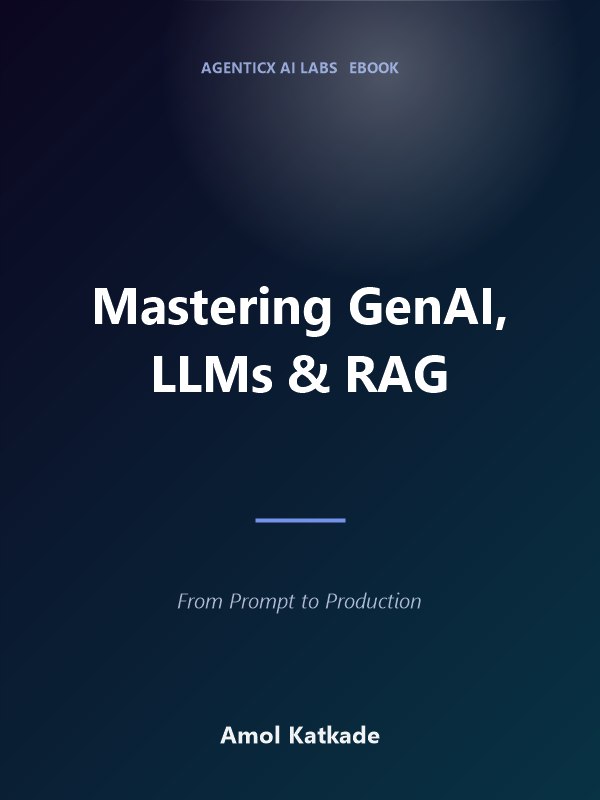
Mastering GenAI, LLMs & RAG
From prompt to production: the complete guide to building with large language models.
by Amol Katkade
A thorough, engineering-focused guide to generative AI: how LLMs work, prompt and context engineering, embeddings and vector search, retrieval-augmented generation, evaluation, and shipping reliable, cost-aware GenAI systems to production.
- How LLMs, embeddings & vector search work
- Production RAG: chunking, re-ranking, grounding
- Evaluation & cost control
- Prompt + context engineering patterns
≈ $4 USD · charged in INR at checkout
30-day satisfaction guarantee · Delivered instantly to your library
From the opening pages
What is Generative AI? Generative AI refers to a branch of artificial intelligence that focuses on creating new data — text, images, code — rather than merely analyzing or classifying existing data. Unlike traditional systems that draw a line between categories, generative models learn the underlying patterns of their training data and produce genuinely new outputs. This book takes you from that foundation all the way to shipping reliable, cost-aware GenAI systems in production.
Table of contents (excerpt)
- Foundations of Generative AI
- Prompt & Context Engineering
- Embeddings & Vector Search
- Retrieval-Augmented Generation (RAG)
- Building LLM Applications
- Fine-Tuning & Customization
- Evaluation & Guardrails
- Deployment, Scaling & Cost
81+ pages · instant PDF download
Reviews & reader feedback
Be among the first to review this guide
This guide is newly published, so there are no reader reviews yet. Early readers who send honest feedback help shape the next edition — and every published review credits you by name, role and company if you want it.
- Launch pricing while the programme runs
- Free lifetime updates to the guide
- Your feedback shapes the next edition
- Credited by name on the product page
We publish honest reviews — including critical ones. Nothing here is incentivised in exchange for a positive rating.
Write a review
Read the guide? Share what worked and what didn't. Reviews are moderated before publishing, and honest criticism is welcome.
Why this book exists
The shortest path here from "I can code" to "I have shipped a retrieval system" — RAG is the spine of the book rather than one chapter in it.
Most GenAI material stops at calling an API. The part that decides whether a system is useful — how retrieval is built, evaluated and deployed — is usually a paragraph. This book spends most of its length there.
Who this is for
- Developers building their first serious LLM application
- Engineers who need retrieval over their own documents
- Anyone deciding between RAG and fine-tuning
Who should not buy it
- Readers wanting the mathematics of transformers — this is applied
- Non-technical readers; it assumes you will write code
- Anyone needing a broad AI overview rather than a build guide
What is actually inside
Read from the PDF itself — 81 pages, not written for this page.
- 1. Introduction to Generative AI
- 2. Foundations of Large Language Models (LLMs)
- 3. Retrieval-Augmented Generation (RAG)
- 4. Building Your First GenAI Application
- 5. Fine-Tuning and Customizing LLMs
- 6. Retrieval-Augmented Generation (RAG) Techniques
- 7. Deploying and Scaling GenAI Applications
- 8. Ethics and Bias in Generative AI
- 9. Integrating RAG (Retrieval-Augmented Generation) with GenAI Applications
- 10. Building End-to-End Applications with GenAI and RAG
- 11. Optimizing Performance and Scalability in GenAI Applications
- 12. Fine-Tuning and Customizing LLMs for Specific Use Cases
What you will be able to do
- Build a GenAI application end to end rather than a demo
- Design a retrieval pipeline and judge whether it works
- Decide between retrieval and fine-tuning on evidence
- Deploy and scale it, and reason about cost
What you get
- 81 pages, deliberately dense
- Separate chapters on RAG fundamentals and on RAG techniques
- Fine-tuning, deployment and scaling
- Ethics and bias, and end-to-end application chapters
PDF, downloadable as often as you like from your library. Access is tied to your purchase rather than to a browser, so clearing data or changing device loses nothing.
What you need first
- Python basics
- Comfort calling an HTTP API
Practise it free
The internship has briefs in this area with the assessment criteria published before you start, and written review on what you submit. It costs nothing, and you do not need this book to take part.
Questions about Mastering GenAI, LLMs & RAG
81 pages seems short for this subject.
It is the shortest book in the catalogue and the most concentrated. There is no history of AI and no vendor tour — it goes from foundations to a deployed retrieval application.
Does it cover evaluation?
Yes, and it is the chapter most readers say they needed. Retrieval quality and generation quality are separable problems, and measuring them together tells you nothing about which to fix.
Which vector database does it use?
It teaches the decision rather than one product, because the right store depends on where your data already lives and how much of it there is.
What to read next
Chosen because they follow on, not because they are also for sale.
Reviews
No reviews yet. If you have used Mastering GenAI, LLMs & RAG, yours would be the first — and it would be the only thing on this page written by somebody other than us.
Write the first review