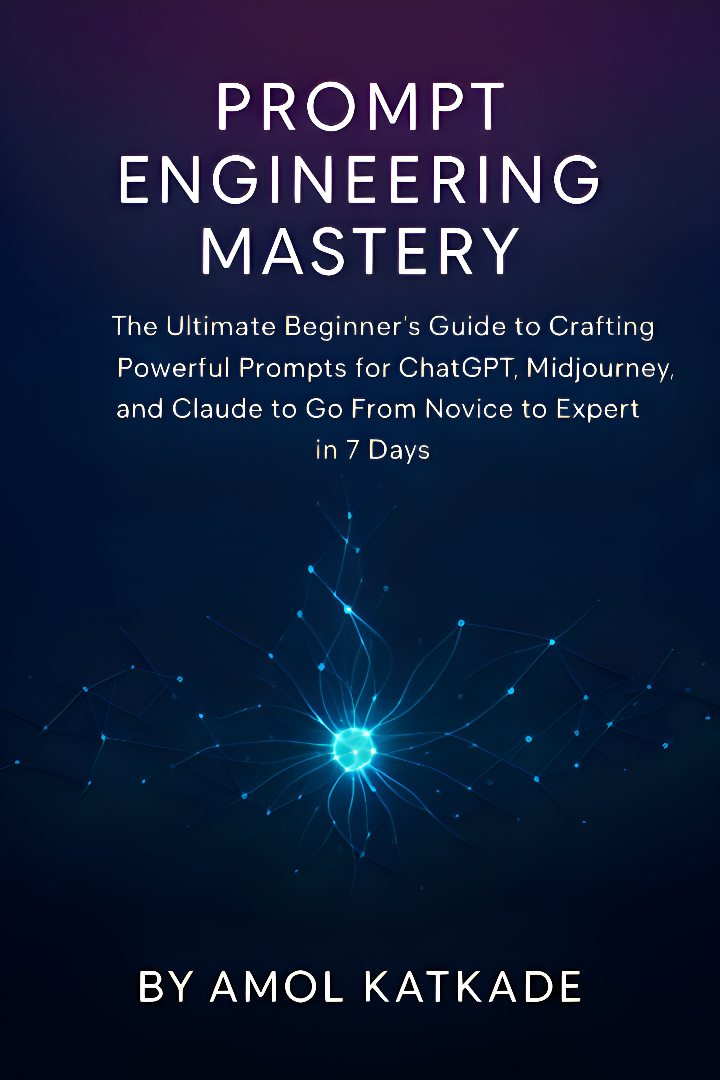
Prompt Engineering Mastery
The ultimate beginner’s guide to crafting powerful prompts for ChatGPT, Midjourney & Claude — from novice to expert in 7 days.
by Amol Katkade
A beginner-friendly, 7-day path to writing prompts that actually work. Learn the anatomy of a great prompt, role and context framing, few-shot examples, chain-of-thought, self-consistency and prompt stacking — then apply them to business, research, creative and coding work, with copy-paste templates you can reuse across ChatGPT, Claude and Gemini.
- A structured 7-day learning path
- Chain-of-thought, few-shot, role & self-consistency prompting
- Prompt stacking for long-form creative work
- Copy-paste templates for ChatGPT, Claude & Gemini
≈ $2 USD · charged in INR at checkout
30-day satisfaction guarantee · Delivered instantly to your library
Reviews & reader feedback
Be among the first to review this guide
This guide is newly published, so there are no reader reviews yet. Early readers who send honest feedback help shape the next edition — and every published review credits you by name, role and company if you want it.
- Launch pricing while the programme runs
- Free lifetime updates to the guide
- Your feedback shapes the next edition
- Credited by name on the product page
We publish honest reviews — including critical ones. Nothing here is incentivised in exchange for a positive rating.
Write a review
Read the guide? Share what worked and what didn't. Reviews are moderated before publishing, and honest criticism is welcome.
Why this book exists
Structured as a seven-day progression from first principles to workflows, and covers four domains separately — business, research, creative and technical — because good prompting differs between them.
Prompting advice is usually a list of tricks with no organising idea. This builds from how models actually respond, through advanced techniques, into domain-specific application and multi-model workflows.
Who this is for
- Anyone using ChatGPT, Claude or Midjourney seriously
- Professionals applying AI to business, research or creative work
- Developers wanting technical prompting patterns
Who should not buy it
- Engineers wanting production prompt architecture and evaluation harnesses
- Readers looking for a prompt library to copy without understanding
- Anyone who already prompts confidently across domains
What is actually inside
Read from the PDF itself — 94 pages, not written for this page.
- Section 1: Introduction to Prompt Engineering
- 1. Understanding AI & LLMs
- 2. Why Prompt Engineering Matters
- 3. How to Think Like an AI
- Section 2: Core Principles of Effective Prompting
- 4. The Fundamentals of Prompt Crafting
- 6. Advanced Prompt Engineering Techniques
- Section 3: Prompt Engineering for Different Domains
- 7. Business Applications of AI Prompts
- 8. Using Prompts for Research & Analysis
- 9. Creative Prompting for Content Generation
- 10. Technical & Coding Prompts
What you will be able to do
- Structure prompts deliberately rather than by trial and error
- Apply advanced techniques — chain-of-thought, role prompting, few-shot, self-consistency
- Adapt your approach across business, research, creative and technical work
- Combine several models in one workflow
What you get
- 94 pages across five sections and 14 chapters
- Separate chapters for business, research, creative and technical prompting
- Workflow integration and multi-model combination
- Ethics and bias
PDF, downloadable as often as you like from your library. Access is tied to your purchase rather than to a browser, so clearing data or changing device loses nothing.
What you need first
- Access to an AI assistant. Nothing else.
Practise it free
The internship has briefs in this area with the assessment criteria published before you start, and written review on what you submit. It costs nothing, and you do not need this book to take part.
Read around it, free
Questions about Prompt Engineering Mastery
How does this differ from The AI Prompt Engineering Guide?
They cover closely related ground with the same five-section structure. This one is framed as a seven-day progression for a general professional audience; the other goes further into workflow building and has a more detailed breakdown. Most people should buy one, not both — and if you want both, the bundle costs less than the two together.
Is this outdated as models improve?
The tricks matter less over time; the structure matters more. Stating constraints, output shape and what to do at the edge is specification, and better models still need it.
Is it really seven days?
That is the structure the book uses, not a promise about how fast anyone learns. Read at whatever pace suits you.
What to read next
Chosen because they follow on, not because they are also for sale.
Reviews
No reviews yet. If you have used Prompt Engineering Mastery, yours would be the first — and it would be the only thing on this page written by somebody other than us.
Write the first review